Monday, 18 November 2013

Alligators and Spaceships - Florida 1998


Me an’ my girl - well, one of them - in Florida. October 1998.


Stephanie, at 14 years old, had one of those daft adolescent obsessions: she was collecting everything and anything dolphin-shaped. Her bedroom was crammed with such crap.

So, when we fixed on Florida as an exciting and exotic holiday destination, the notion of swimming with real-life dolphins arose. She swam like a fish herself, anyway; on a “swimathon” in Telford, she had gone on for mile after mile of slow, stately, streamlined lengths of the pool. Her shape is curvaceous and athletic, a shape inherited from her great grandmother Lilian Russell, a swimming champion before the Great War.


As a parent, it is most satisfying to make the dreams of one’s offspring come true. Stephanie absorbed all the instruction given by the Dolphin Centre staff, listening intently to the do’s and don’ts of relating to these intelligent mammals with an almost spiritual aura. They would be watching her through one beadly little observant eye as she looped around the pool. When it was all over, she was quiet and subdued – the tranquility of somebody on Cloud Nine.


(Could we just clear up an earlier statement – swam like a fish herself. I am well aware that dolphins are not fish. I have a recording of a four-year-old Stephanie talking to me over a picture-book. At one point, discussing the phenotypes of the animal kingdom she exclaims in a chirpy, musical, French-accented voice, “dass not a way-ull! Dass a big feesh!”)

 
Not a big feesh, and that's final!

Florida being, in the British mind, synonymous with theme parks – especially Disney-sodding-land – I was determined to make the experience more meaningful than going on a series of rides. Even the best theme park ride is little more than a short term thrill; you can hardly tell people about it back home; it is to adventure what fizzy pop is to real nutrition – all of the appearance and none of the reality. But this was Steph’s trip as much as mine, so we agreed that we would alternate between Dad-days and a Steph-days. But I would not set foot inside Disneyland; would not even pronounce the D-word. When I see grown men dressed up in cartoon outfits, transmitting cartoon body language, I have an urge to snatch the great mask off their heads, look them in the eye and scream, “You were not born to this demeaning work. You could be something noble such as a coal miner. There, you are free! Flee! Take wing my litle one!” Or sommat like that, anyway.

So on Dad-days, we had some adventure. Original experience not prescribed by any overcautious engineer with a degree in delivering British Standard Thrill Units to brain-dead and passive punters.

On one such Dad Day, we passed a shooting gallery. “D’you fancy it?” I asked Steph. We parked up, and entered through the glass doors, feeling a little self conscious. Would the place be full of aggressive gun-nuts? Stephanie was up for it in principle, and I confirmed with the warmongers inside that 14 was not too young to have a blast. “Oh, we have people as young as ten come here and shoot,” said the beefy moustachoied manager. So I asked Steph if she would like to have a blast. She declined.

They asked me what I would like to shoot with. Inside the glass cabinets was an obscene array of gunmetal-grey lethal hardware. Let us not forget that these weapons are made to kill living creatures, including human beings. Faced with such choice, such abundance, such a macho testosterene-filled sack of toys, I went in the opposite direction to the prevailing ethos and asked for the simplest gun they had.

“Oh, then how about a revolver? A twenny-two.” (Translation: How about a simple hand-gun as opposed to a feckin machine pistol that sprays bullets out like a hosepipe. How about a revolver, a thing with six bullets in a revolving chamber rather than a square magazine that slots into the handle and fires a dozen bullets in quick succession. How about a 22-calibre bullet (a tiny one) rather than a great big thing that would sit heavily in the palm of your hand?)

So I take my little handgun, my ear defenders, and my squalid little box of fifty bullets. I go forward into the shooting gallery. It is set up for six shooters (not six-shooters as in Billy the Kid, but six enthusiasts like me). The shooter stands in a sort of stall, like a horse in a race, with up to five like-minded people either side. Over to my right, Stephanie is watching through a plate-glass window. In front of me, maybe twenty yards away, is a cardboard target. I decide to stand lags apart with both hands on the pistol, which I believe I have heard referred to as the "Weaver Stance", and begin to fire at the target. It kicks lightly in my hands. Pop-pop-pop-pop-pop-pop. I open the chamber as shown, spill out the empty shells into a bucket and (taking care to keep the weapon pointed downrange as instructed) and insert another six bullets. Pop-pop-pop-pop-pop-pop. Such fun!

As I am doing my modest thing, a person steps into the stall on my left. This is one serious dude. His gun is three times the size of mine. I think it is a Colt 45. When he fires his first shot, the noise hurts my ears, even through the ear defenders. He is theatrical. He fires with only one hand. BANG! He goes down one one knee, and blasts a shot off. BANG! I do not turn to look at him. I don’t want any trouble. This guy is Dead Eye Dick, or Dirty Harry, or Slim Pickens, or just another silly boy with a toy. Afterwards, Steph would say to me, “Daddy, your gun only sent out a bit of smoke, but that man’s gun had a great flame coming out of his.”

And then I hear an angry raised voice speaking to Dead Eye Dick. It is the Range Warden. “I told ya not to do that, ya goddam idiot! I told ya! Get the hell outta here!”

When I have finished popping away at my targets, and am safely away from the action, I ask the Range Warden what he had so exercised him. He angrily tells me that the man on my left had had a problem with his gun. It had stopped firing, and as a way of investigating had turned the gun towards himself and peered down the barrel.

 I ask the Range Warden if, in this land of crazy gunmen, he often had deranged local people doing dangerous things. “No!" he snarls in a gravelly voice, "He wassunt an American. He was an Englishman like you!” Oops!  

-------

On another Daddy-Day, we drive across the width of the tongue of land that is Florida to Cape Canaveral. As a lad, the exploits of the Americans and their heroic astronauts filled me with admiration. I followed the Mercury programme with its solo astronauts, the Gemini programme with its pairs of astronauts, and the Apollo programme with its trios. After leaving the Earth’s orbit, and doing practise circles of the moon, they landed on it in 1969. For the next few years they went back, ever more ambitious, even driving around the dusty surface on “moon buggies” until dropping the whole thing.

Today, in 1998, there will be a Space Shuttle launch. The crew will consist of the usual fit scientists and military men in their thirties, but also the oldest man ever to go into space. John Glenn, or rather Senator John Glenn as he now is, was the first American to orbit the Earth in a Mercury capsule. (We should not forget that other Americans went into space before him, on so-called sub-orbital flights, strapped onto unreliable rockets designed to do little more than lob a nuke onto the Russkies. We are also not likely to forget that the Russkies beat them to orbit, with Yuri Gagarin circling around above their heads whilst America’s rockets exploded spectacularly on the launch pad time after time.)

And today, septuagenarian John Glenn was going up again, forty-plus years after he made history.

In the coastal towns around the Cape (renamed Cape Kennedy for a couple of decades until the notion of naming such features after recent dignitaries was declared unworthy) they had not seen such a turnout for many years. Amazingly, Space Shuttle launches had become routine! People had almost lost interest in the four-monthly launches of these wonderful machines. The crowd of sightseers has over the years been steadily dwindling, and the John Glenn mission was an exception, a pleasant reminder to the locals of past glories. They try to charge us to park in the sidestreets of their coastal villages. One young woman holds a placard inviting us to turn back to Jesus.

Looking out eastwards across the Atlantic, we await the launch with electric anticipation. At tee-minus-ten, the launch is suspended: some dickhead in a Cessna light aircraft is circling the launch pad too closely. We waited impatiently while they did what they had to do (maybe chasing him off with military jets). We could visualise the astronauts in their space suits, lying on their backs, breathing in the oxygen, tenser than us mere spectators. And then, thrillingly, the count recommences.

Through somebody’s car radio we hear the dramatic countdown. For me, the passage of time has never been so dramatic, so palpable, so irreversible. As the seconds drops from the thirties and twenties to the lower digits, an almighty yellow-white flame appears in the distance, and the crackling sound of superheated air reaches our ears, and the mighty spaceship muscles its way up, above the restraining gravity of Planet Earth, and gains speed poised on its sparkling burst of fire, and crackles off into the sky, into the distance, towards the horizon, leaving behind it a plume of passive smoke.

I could hardly contain myself. Emotions washed through me. I was struck by the contrast between the excruciating pain of the pre-launch delay and the bollocks-out action of the real launch. These Amercans  I thought,  they either don’t go for it or they go for it full-on! Next to me, my callow adolescent daughter was disdainfully wondering why these old guys get so carried away by such mundane things as a spaceship launch. Can’t he be like normal people, I imagine she was wondering, and get excited on a roller coaster?

In the course of sampling the different cuisines on offer, I had been shocked by the paucity of American cuisine. Wherever we went, it was lower than canteen food. Part way through our trip, we discovered Cuban cuisine, and Italian restaurants, and others. But there is no such ama-mull as authentic Yankee grub. The low point came in the …. wait for it…. International House of Pancakes, where a stack of floury slabs was placed in front of me. Maybe four thousand calories on my plate. A squalid jar of mock-maple syrup to pour upon it. After a quarter of this calorie-fest I was bloated, and had to stop, embarrassed at wasting enough food for three people, imagining my mother mentioning all the starving children in India.

On one occasion, in a Chinese restaurant, I was so impressed by the spectacular grub that I took a photo of my plate. When the eating was good, I would make “yummmm” sounds, like some theatrical luvvie. “Ohhhhh, yeeees!” Stephanie put me down with teenage skill: “Why can’t you just enjoy your food like normal people without making all this noise?!”

On Steph Days we did the theme parks. There were some spectacular rides and water slides that will last in my memory until… er… 1999.

And as part of Dad’s Days, we hit the famous Everglades. Situated at the southern tip of the Florida peninsula, the Everglades slope downhill at a microscopically small rate. I mean the gradient is so slight it's literally as flat as a bowling green. The figure is something like an inch a mile. This has resulted in endless grassland, or maybe reedland, where the mosquito is king, and where the local indians were a hardy bunch indeed. I think they were called the Pepsi Cola tribe before the white men heroically wiped them out. Nineteenth century technology was more than a match for the snivelling stone-age barbarians that had occupied the continent for only a millennium or two.

We hired a canoe. To begin with I took the front position. We were hopeless. We could not go in a straight line along the twenty-metre-wide channel, literally hitting one side or the other. Whatever musclepower I expended we just could not advance in a straight line. We figured out that the rear oarsman had more control and so swapped places. Now we had it! Smooth and coordinated, we got up some good speed, and got out of the channel into a lake which was a bit choppy so we retreated back into our channel.


A guy came past in a powerboat, throttling right down out of courtesy, and said, "You guys seem to be working smoothly as a team", which was true. Our minds were frantically calculating moments of inertia around the centre of percussion, and drag limitation via minimal y-axis oscillation. Some, understandably, might say smoothly.

We noticed a little landing platform and parked up for a walk on a dry pathway among the mangroves. And then the mosquitos started on us. Our little stroll became a run and then a mad dash to try to outpace the bastards. I was trying to swat them from my face and legs and calves all at the same time, hopping and flailing and running and jumping. This was too much for Steph. She 'corpsed' - the sight of her crazy old man doing this deranged dance gave her a fit of the giggles and she couldn't run for laughing. The mossies made her pay for that, devouring her whilst standing stationary and shrieking with laughter. We later counted the bites on her legs: there were around a hundred.

Retreating back to the boat, and safety, we noticed a crocodile in the water, just eyes and snout showing, and an alligator basking on the bank. "Let's get a photo, Steph!" We approached a bit closer. "Still too far, Steph. A bit closer please!" Wicked swine that I am, I wanted to see a look of fear on her face before clicking the shutter.


Years later she confessed to hamming it up, feigning terror in order to make the fool behind her click his stupid camera.

On that Florida trip we had the most diverse fortnight imaginable. We met up with my sisters and Steph's little cousins; we drove through the tail end of Hurricane Mitch; heard our food being crunched in the darkness by cockroaches in fetid motel rooms; and survived to tell the tale!  

Wolfhounds & Vampires - Transylvania 2000


Approaching Dracula’s Castle


Transylvania, September 2000.


The cable car took me up into the mountains. As it rose, I reflected on just how much effort and aggro this alleviated. I'm headed for Dracula's Castle in Bran, via the Carpathian Alps, or as this stretch is known, the Transylvanian Alps. Since almost every aspect of life in Romania is tainted by corruption there is a risk that this cable car may be unsafe - for instance, if the proper bolts cost £5 each and a similar one £1. If this fraud is discovered by an inspector, well his mouth can be shut for a certain sum. But all's well that ends well and we make it to the top.

Exiting the upper station, the scene was rather barren. There would doubtless be hordes of people here in the high season, but there were in fact less than a dozen of us in these high spaces. A Saint Bernard dog was led among us by a hawker hoping for a few tourist-dollars of photo fees. And there was a woman in girly shoes and a leapordskin coat wobbling over the mud and scree


One of the regrettably few photos I took in Romania

Alone at last, I worked up a good sweat heading off across a ridge, and down, to the Gorge of the Bears. In the side pockets of my rucksack were a dozen party poppers. These childish plastic cylinders would emit a slight explosion and a few coloured paper streamers. If the name of this gorge was meaningful, I might need them to frighten away any hungry bears. I tried one out. The result was unimpressive. Against the white-sound rushing of the river, the explosion was like a slight cough. Deterrant value: zero.


The attraction of the Gorge of the Bears had lessened somewhat on the flight over. I had got into conversation with a couple of American engineers, coming over to install a donated body scanner to an impoverished Romanian hospital. “Gorge of the Bears, huh? You ever met a bear before?”


“Well, no, actually.”


“Where will you be sleeping?”


“Under a poncho.”


“And where will your food be?”


“In my rucksack, under my head.”


“Bad move. Bear smells the food, he’ll come through you to get to the food. Doesn’t care that you’re in the way, he’ll come through you to get to the food. We were setting a machine up in a hospital in Alaska last year. They brought in a headless corpse. Bunch of guys were doing some blasting, back of Anchorage. They woke up a Kodiak bear. Nasty son of a bitch a Kodiak. Angry bear wakes up, nine feet tall, takes this guy’s head off with one swipe of his paw, then goes back to sleep. But you should be OK – probably only brown bears in Romania. But hang your food from a tree, not under your head.”


Gulp.


I decided that it would be impossible to sleep whilst fearing the unheard approach of a bear and made my way upwards, beyond the tree line, into the barren grassy upper slopes. From time to time, heavy rain would come down. Despite sheltering in a crevice, I ended up soaked. Continuing my ascent, I reached a place where rhododendron-like bushes grew in a strange horizontal fashion, doubtless to resist the winds. There was enough dead wood to make a respectable fire, and I was able to dry out my kit under my sheltering poncho.


The next morning, a couple of fit young astronomers awoke me as they skipped up the slopes heading for the observatory up top. When finally I got up top and passed the observatory, I reached a high ridge, with glacial valleys radiating to all points of the compass. The sky was clear, but a ridge of cloud was moving towards me from the North, coming in fast on the same level as the ridge like a car ferry heading into Dover harbout at full steam. As it hit, the wind got up, the day darkened as if a curtain had been dropped, and in minutes snow was falling. I sat on a rock and huddled under my poncho, shivering, waiting it out, wondering if I really was in control of the situation.


It passed, the sky cleared again, but I was disoriented. The valleys all looked the same. It took a while with compass and GPS to figure out which of the valleys led down to my destination, the town of Bran where Dracula had had his castle. Heading down the steep slope into a wide scooped-out alpine valley where sheep were grazing in the distance, another wave of cloud hit. The thick clouds came rolling down behind me as if somebody had let off a fire extinguisher, rolling down the slope and enveloping me in thick mist.


Again clear, I carried on down to the level ground, and made my way past the grazing sheep, heading towards where the meadow narrowed before sloping down again towards Bran. At the neck of the valley was a shack. This was where the sheepdogs lived. A couple of hundred yards from it, they spotted me, and came to check me out, woofing away in a deep bass. As a former paper boy, I thought I knew how to deal with aggressive dogs, which is to point at them and shout “down” in an authoritative way. But these were not yappy little Welsh sheepdogs. These buggers were three feet tall, their role in life to take on wolf, and were unimpressed by a former paper-boy. They kept on coming, their fangs and hackles out, and were making for my calves. Fortunately, I had my trusty party-poppers. With the circular disc, and streamers, removed, they are a lot louder. I let a couple off, and the dogs relented, scurrying back to their den.


I passed the neck and took in the craggy route down. The choice of route would be critical. You have to choose a path which will lose altitude fast enough to get you down, whilst avoiding precipices. A flat sloping ramp is the theoretical ideal. In practice the rule is not-too-sleep and not-too-shallow. From below, a strange call came echoing up the valley. Starting with a high, falsetto note, the pitch of the voice descended, though the falsetto break, and tailed off into a gurgle like somebody groaning or complaining. This must be yodelling. I had always thought of yodelling as being a form of alpine singing, for entertainment purposes. But I realised in a flash that it is in fact a means of making the voice carry great distances in a silent environment, using the natural resonance of the terrain to make it carry the sound. Somebody was observing me, but my eyes were not good enough to see them. I gave a large shrug, hoping that they would see that I didn’t know how to respond.


 At a certain point, I made the wrong choice, and it got steeper and steeper. Beyond the immediate way forward, it was looking like misty space. Should I go forward or retreat back uphill? I went on. I reached a point where the only way forward was under a massive boulder sitting on a flat ledge. Going down on all fours, I edged sideways along the giant saucer, the boulder being a giant cup, and a sheer drop to the kitchen floor underneath. On the far side of the teacup I found a dead end, and was obliged to retrace my steps.


Grinding back up the gorge, I was alarmed by a human voice to my left and ten feet above me. The man was a fit looking young fellow with short beard, boots and woolly calf-socks. We continued uphill to where our paths converged, and entered into conversation. With the aid of my dictionary, and lots of body-language, I asked him who he was.


Me: “Baah, baah?” (Bleating like a sheep.)


Him: “Da!”


“Doggy doggy woof woof?”


“Da, da!”


He then made the sign of somebody shooting a pistol. Aaah! He has come from below to investigate the sounds of shooting! Again, with lots of body-language, I explained that his dogs had attacked me, and then whipped out a party popper to demonstrate how I had frightened them off. When I let it off, he went “Aaah! Hahaha! Da, da!”  (Translation: Aah, so that’s what happened. I thought some idiot was shooting my sheep!)  


The shepherd pointed out to me the proper route down. We parted company, and I took the path. At a certain point, a steep precipice presented itself - steep but not vertical. Nailed into the living rock was a steel hawser. How high? Maybe a couple of double decker buses high. Rucksack on back, I went down into the void, hand over hand, hoping that I had enough strength in my hands to reach the bottom before my grip loosened. After the precipice it was a walk in the park. From below there again came the sound of yodelling. This must be Daddy, asking the shepherd if he was OK. From, above, the shepherd answered. The conversation continued. I imagined that Dad went on to enquire what his son wanted for dinner, and that son was replying (in yodelly-screechy sounds as if he was being stabbed to death) that he wanted beans and chips.


The slope was now perfectly manageable, and I made my way through mile after mile of forest meeting, on the way, a team of lumberjacks felling the trees with axas and a chainsaw. A wizened old grandad gave me a sip from his hip flask of some vicious spirit. I asked them about bears. “Da, da, muy Urs” (yeah, yeah, there are lots of bear in these parts).

 
I couldn’t reach Bran before nightfall, so camped out near a stream. I made an all-night fire using big logs, and improvised my anti-bear defences. Using the string that I always carry, I put a cordon - a ring of string around me on twigs pushed into the soil, and inserted party poppers into the string in series. I experimented, deliberately tripping the string. The party popper gave a satisfying bang. With my food hung up in the branches of trees, and safe within my circular booby trap, I managed a proper night’s sleep. Next to my head I kept saucepans and spoons, ready to make a right old clatter if the local bears decided to pay me a visit.

 
Sadly, in my time in the Transylvanian Alps I saw not a single bear. Dracula's castle was everything onemight expect, with pointed turrets and battlements and arrow slits. Perched over the town, it spoke to me of might-being-right; it said, You peasants below might as well stay in your places because we're the Lords and even a million of you can't storm THIS baby. After an hour of rubbernecking at the castle I was bored, reminding myself that I don't do monuments.

Lonely Planet spoke of a certain village where the people were so keen on music that they would go into a frenzy, carried away by the gypsy violins, whirling away into a state of.... this account was a load of made up crap. I made my way there via Tirgui Mures, and hitched a lift with Martin Balla who happened to live there. He explained that the people of his village most certainly did not whirl or swivel, did not go into musical fenzies, and found it odd that I should think they did. He invited me into his home to stay a night or two.

In the evening, translating through his daughter, he told me that everybody was now going off to church; that I could stay in the house or come with them as I wished. Yeek! Thinking it illegitimate for a stranger to be alone in their nice house, I said I'd join them. But, Martin explained, I did not have a hat! Only hat-wearing worshippers may enter the church. So we go to the hatmaker. All the local men wear a straw hat, rather like a trilby, and I clearly must buy one for church. It is not cheap - I think it cost me twenty five @#£% quid.

We go to church, me in my new hat, them in their old ones. They all sing. I try to look... what adjective describes worshipfulness?... pious perhaps? Angelic? Anyway, I get away with it.

Back home, Martin asks me, through his daighter's language skills, how often I go to church.

B: Oh, not as often as I... haha... jolly well should, Martin. (Expression a bit Bridget-Jonesish.)

M: Right. SO how often is that then, Brent?

B: Oh, you know, christenings and funerals mostly. And, ah, the occasional sunday....

M. Are you a Christian?

B. Oh, haha, you know, ah..... I try to... well you know.......

M. (Looking me straight in the eye) Do you, or do you not, believe that God sent his only son Jesus Christ to Earth in order to save your soul and give you eternal life?

B: (Looking like I've confessed a guilty secret) Er, no, Martin.

M. OK. That's fine. At least I know where we stand.

Martin was no fool.


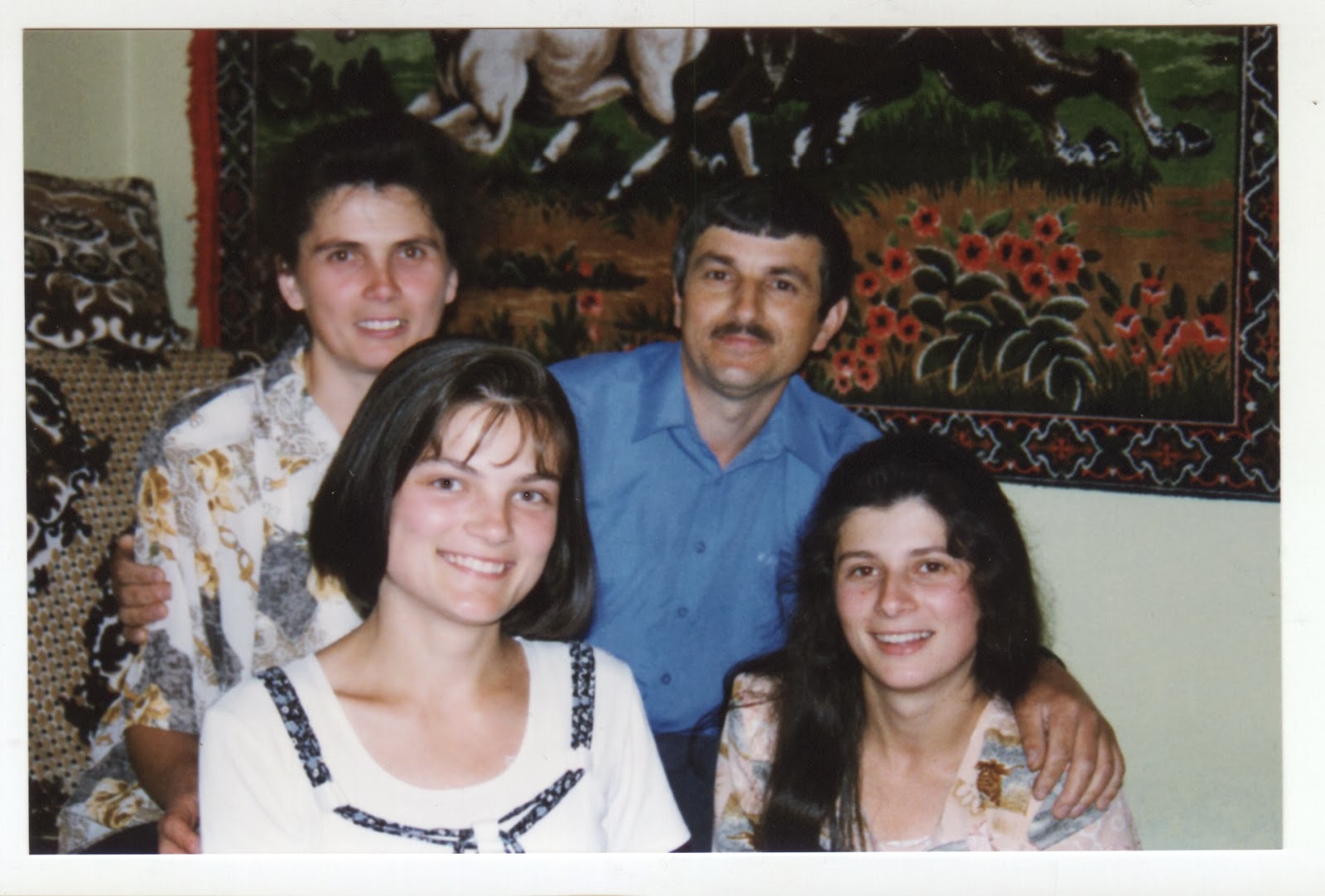
The Balla Family
 

Transylvania is historically Hungarian but today is, of course, in Romania. I imagine a lot of blood has been spilled over the centuries. I subject Martin to the Tebbit Cricket Test.

B: OK Martin, let's suppose that Hungary are to play Romania at football. Who do you shout for? The country you live in or the one over the border?
 
M: Er, Hungary.

B: OK. That's fine. At least I know where we stand.

#####

Overall, despite some vivid experiences, Romania is just a bit too drab to justify the effort.


Sand Seas and Satellites - Morocco 2006


Sand Seas and Satellites                                                                    Morocco, April 2006

The mule’s rear hoof stumbled on a loose stone and it missed its footing. The hoof folded rearwards as weight went onto it. Instead of falling over – with me on its back – the marvellous beast managed to keep us upright by standing on its wrist.

Over the previous couple of hours I had learned to put my faith in her ability. She was as sure-footed as a... well, a mule. The path we were following was a narrow ledge, a horizontal contour snaking along the bare grey hillside. To the left it sloped gently up; to the right steeply down. Hardly a “precipice”, but nonetheless life-threatening if we were to cartwheel a hundred metres down the abrasive shale which would flay the skin from a tumbling human, flay the hide off a tumbling mule.

We were in Morocco’s Atlas Mountains – a name to conjure with. Ahead of me, nested in the enormous cloth saddle, little Charlie looked carefree and comfy as an Indian prince on his mule. Ahead of him, Tish in her wide-brimmed “adventurous hat”, unaware that I am studying her horsewomanship. How does she make it look so easy? Her slim waist was flexing and adapting to the movement of her mule, her shapely bottom wiggling this way and that. Very attractive, I thought.   

Behind me, Harriet gave out a squeak of alarm: “Oh my God, did you feel that, Brent? Your mule went down on BOTH legs, the poor thing, and just carried on.” She may have used a horsey word like “fetlocks” instead of “wrists”, she being a horse enthusiast. She was in her element – very pleased to be be on muleback. A few days before, this little trek was in doubt. I was glad that we had made her modest dream come true after all.


Mule Train. And Barbary Ape. Same species as at Gibraltar. In fact this is a misnomer: it is not an ape but a monkey, as evidenced by the lack of a glint of intelligence in its eyes. 

Beauty surrounded us. The simple beauty of primary colours: a big blue sky; the ash-grey bald mineral undulations of the Middle Atlas; the deep healthy green of the brooding and patient cedar trees. These curious creatures have an unusual geometry. Instead of tapering gracefully, the trunks rise almost cylindrically, like telegraph poles. As a member of the fir family (and their sticky, gooey, cones exude a scent which confirms this), the eye is puzzled that the outline of the branches is not a Chrisrmas-tree pyramid. These trees are of an ancient species. One can imagine a Stegasaurus smashing into these gawky trees with their tusks and gorging on the the nutritious cones. The cedar’s clever relatives have evolved, becoming more flexible and more fertile, and have conquered Siberia and Canada. But the stately cedar has been banished to barren margins such as this, a niche ecology of no interest to johnny-come-lately Christmas trees.

In ancient times, the cedars of Lebanon flourished. In ancient times, the Persian Empire contained such slow-growing forests. But mankind has pillaged such treasure-troves for aromatic bone-hard timber. Deforestation of such places is an act of greed and ignorance: once gone, the forest does not grow back. Enclaves like this (protected species in a World Heritage Site) are rare on the planet.    


The Cedars of Barbary

So we are privileged to be here, riding our mules, rubbernecking at the contours and hummocks and peaks and outcrops, enjoying the three-dimensionality of it all as the foreground parades in front of us and the middle ground more slowly, so confident in the mules’ surefootedness that we can raise our eyes and drink in this awesome scene.

Up and up we rise, reaching a “saddle point” – a pass between two dry valleys, taking a sharp right turn to follow a ridge, as if riding along the backbone of a whale, admiring the landscape in not one valley but two. Can we hear music? We turn our heads left and right to negate any wind. It sounds like pipes. Where is it coming from? There. Way over on our left. On the downward slope, facing us from the far side of the valley, crisply visible in this dry air is a swarming mass of black dots. Sheep? No, goats. And where is the musical goatherd? There he is. No, there, sitting on a fallen tree trunk, spinning his musical magic for his own pleasure, probably aware that we are trooping along the far slope and probably unaware that he is touching our hearts with his simple art. 

We are heading for an isolated village, a Berber village. We will get there by early evening. But the mules’ owners, who are walking alongside us, will have to make the return journey in the dark. The price we pay for all this is tiny. But the company who organized it for us is adamant that tourist income is a significant benefit to villages like these. So we feel more like travellers than tourists. More like guests than travellers. Rather than exploiting the locals, we feel that we are joining in with something.

An hour before, in great discomfort, I had been on the brink of dismounting and footslogging it instead, such was the pounding  on my poor bum.

But my observation of Tish’s technique paid off. I twigged it. One’s spine must be supple, not rigid: in this way, the horse’s pitch roll and yaw can be dissociated from one’s own torso, which can progress in a smooth straight line. Additionally, one‘s centre of gravity must be maintained over the horse’s own centre of gravity.

With this new insight, mule riding became a pleasure, not an ordeal. I like to think that my mule sensed the newfound harmony. We became a team. She was quite competitive – forever running into the hind quarters of the mule ahead and when becoming lead-mule anxious to stay in front. I began to use the mule’s own initiative: point her in my desired direction and off she’d go. Unlike a car, she didn’t have to be directed every step of the way. We would build up a lead, and then stop for a snack. But as soon as the competition caught up she would stop munching up the green stuff and skedaddle back to her rightful place at the head of the convoy.

Suppleness, balance and harmony: surely this trio of qualities is useful in one’s wider life!


The Sahara. Say it with passion and emphasize the second syllable. The Sa-HA-ra!

Of course, the Sahara isn’t all sand sea. Much of it is gravel or rock or polished black crazy paving. But this place, the “Erg Chebbi” is the Real McCoy. It is a sea of dunes. Some of them are gigantic, all of them have graceful curves. Even an atheist can see that there is a pattern at work here, some organizing principle. A beleiver will see the hand of God sculpting this beauty.

“Erg Chebbi” can be seen on satellite images. It’s shaped like a giant teardrop. When you’re in it, with only dunes as far as the eye can see, you think that it’s going to be like this all the way to Egypt. In fact, it can be crossed in only four hours on camelback. To be riding a camel in this pure, clean environment can be deeply soothing. The hateful 4WDs can sometimes disturb the peace, but it is rare.


Charlie of the Desert; Harriet of the Desert

We had taken taxis from the city of Fes, southwards across a fertile plain, up into the mountains, across vast bleak high plains, past snow-streaked hillsides, down fertile valleys where the green fecundity contrasts spectacularly with the sterile, humus-free, orange rocks either side, ever dryer, sand drifting across the road, mirages fibrillating on the horizon. The moist atlantic air is clawed out of the sky by the Atlas. Air on the far side is dry. Some of the rainfall gets funnelled into farside rivers, which send out well-intentioned green shoots into the desert. But these rivers are doomed. After their early successes (emerald green palm groves of lusty fruitfulness), they dwindle to a trickle and die in the desert, a last gasp of evaporation. In Roman times, said Herodotus, these rivers arced round to the right and reached the sea. Crocodiles ventured up them. But no longer.


Can it be any clearer than this: where there is water there is fertility and wealth; where there is none the bare bones of the Earth show through. Shropshire would look like this without water.

Our hotel backs onto the sand sea. We can hardly believe our luck in chosing this place from a guide book. Le Kasbah du Touareg has mocked-up crenellated fortifications. We manage to forgive them that lack of authenticity, because genuine kasbahs don’t come with azure swimming pools, nor straw parasols, nor beautifully-tiled bathrooms. After several nights under canvas, we relish our comfort.


The place is run by a laid-back dude with Berber teeth called Hassan. He’s happy to guard our surplus baggage on Night 2 when we troll off into the desert on our camels, and even on Night 3 when we go off freestyle to pitch our tents somewhere out-in-the-void. Oo-err, missus, how daring are we???


Charlie's room (everybody's room, in fact); Oasis in the Erg Chebbi; Hobbled camel - arab equivalent of the wheel clamp. (This certainly looks cruel but I suspect without having proof positive that this ancient practice causes no pain or damage to the animal.)


"Yeah, yeah, you're drop-dead gorgeous...."

Let’s fast-forward to Night 3 at the Erg. We have found a clump of trees on a promontory on the side of one of the great dunes. We pitch our tents inside a circular perimiter: the trees stand guard over us like waggons in Injun Country. The kids zip up and go straight to sleep - pooped after the hot exertions of the day. A pity, because astronomy is on the menu tonight. A meteor shower is expected – Perseids or something. But after a half-hour of stargazing, during which we spot a silver satellite crawling through the constellation of Ursa Major, the kids have retired for the night. As I return to our promontory, toilet roll in hand, I spy…. with my boggling eye…. a gottverdammt holy-moses whatthehellisthat fiery streak in the sky. It looks like a comet! It is as big as my outstretched fist. And it’s moving. I squeal the discovery to Tish and we watch this awesome celestial display as it processes before our eyes, from left to right, heading northwards with the stately consistency of a flying house. I am torn between snapping it and looking at it with my eyeballs. My experience at the 1999 eclipse was useful here – I devoted three quarters of totality to sodding around with a camera. This time I want to SEE the darn thing.


Our room marked with an 'X'.

The show lasts for a minute, maybe just two. Towards the end, the thing is breaking up and some of the particles combust with a lightbulb flash. Have we seen the Perseid to end all Perseids? The actual core comet that caused the piffling showers of microscopic micrometeorites? Or was this a man-made satellite returning to Earth?


We later find out that this was satellite Sich-1M, whose 3rd stage booster had failed to ignite, leaving it in an elliptical orbit of 160 x 320km, rather than the intended circular 320km orbit. Launched from the Ukraine in 2004, and grazing the upper atmosphere more heavily at every orbit, its fiery end was a mathematical certainty.

Our trek into the desert is not a great adventure by any means. But I keep reminding myself that it’s a bigger deal for the others, especially the kids. The afternoon heat was quite challenging when we set off with our rucksacks on our backs. Like a skittish horse, Harriet refused some of the jumps. She was not prepared to walk directly out into the fiery furnace.

With great skill, Tish found the solution: We would proceed in small stages, using clumps of trees as our stepping-stones. We could rest in the shade for as long as we wanted, and only move on when Harriet was content to do so. After an hour or two we reached a sizeable clump of trees – stepping-stone number 6 or 8. There was water! A well, made of circular concrete hoops, was near the clump. Local people would stroll over from the town and fill their buckets. Perched on gnarled tree-trunks, we did a little cooking, but our enthusiasm for the grove was sinking rapidly. There was much broken glass, most of it just under the surface of the sand, waiting to cut little feet. There were discarded sardine tins. There was constant human traffic – hawkers hawking, children begging, adolescents squabbling. This was a far cry from the pure serene desert experience. So when the sun’s fierceness abated, our little column moved on.


"Just to that next clump of trees, Harriet, and then we'll stop...."

Struggling up the fluffy leeward side of dunes, admiring the ripples and curves and knife-edge crests, passing flat patches with some slight vegetation encouraged by camel droppings, adjusting our “sheshes” whenever the wind would blow sand in our faces.

We had bought our sheshes (or is that cheches?) – a couple of metres of fabric to be worn in a stylish turban – the previous day in the town of Merzouga. In a little shack on a dusty street we enquired about prices. The trader, Abdul, took our breath away with his price: ten quid each!! He kindly suggested that we could buy at keener prices in the local “co-operative”, where they make many things. He took time out from his own shop to escort us there down dusty streets and narrow alleys between mud-and-straw houses to his cousin’s place. We ended up in what appeared to be a carpet shop, and were treated like honoured guests. Out came the mint tea and some snacks. We sat on a carpet and thrilled to the exoticism of the experience. We already felt a degree of obligation to buy something. Glass cabinets contained minerals and trinkets; clothing and carpets; musical instruments festooned the walls.


In the world of fashion, with confidence you can pull anything off...


 Or perhaps not...
 
After finishing off another group of guests, our gracious host gave us a most enlightening talk on the desert people, on the manufacture of hand-made carpets in isolated villages, on the many months it takes to make one. There were four tribes in Morocco: the Berbers, the Touaregs, the Nomads and the Bedouin. His name was also Abdul. He spoke an excellent English. He showed us some stunningly beautiful carpets, and explained the symbols and patterns: “This zigzag represents the wanderings of the Touaregs in the desert when they refused to be turned into farmers, preferring instead the freedom and hardship of the desert.”


Oi, hands off, Abdul! That's my bird...

 
We sadly told him that we could not think about buying a carpet. We were not rich people. We could not go lugging a great carpet into the desert in our rucksacks. We fully acknowledged the beauty of his carpets, and any price we offered would be an insult to the months of hard work in these distant villages.

But it was Tish’s birthday, and she had fallen for a beautiful red and blue carpet drenched in symbolic meaning and history. Abdul offered it to us at a crazily low price, which he then almost halved because he liked us and Tish had become so moved by the experience that she burst into tears. So we walked out the proud owners of a magnificent carpet. And also…. Four sheshes. My blue one was the colour of freedom and the sky. Charlie’s orange was the colour of the desert. Harriet’s mauve was the colour of hospitality. Tish’s beige was the colour of hope. We all looked magnificent in them.

The excellent Hassan – hotel owner – questioned the veracity of the meanings of those colours. In fact, he closed his eyes and almost despairingly head-butted the steering wheel at the sheer…. the sheer nonsensicality of the proclamations of Abdul…. who wasn’t called Abdul in any case.

Now, my take is rather different to Hassan’s. I was well aware that some of Abdul’s statements were – shall we say ‘open to challenge’. I was also aware that we don’t get all this palaver in the Telford Retail Park. “This palaver” was an exquisite floor show as good as ‘An Evening with Ken Dodd’. We shall forever think of Ali Baba’s cavern when we look at our Berber carpet, and think fondly of a memorable birthday for my beloved Tish.

-----------------------------       

Three of our days are spent in the Middle Atlas on an organized trip complete with 4WD and guide, Hassan. He is a dapper little dude with a genuine love for these mountains, these people, these gorges so beautiful that one’s heart gives a little flutter. Hassan is clearly gratified that we appreciate these wondrous places; he must on occasion feel he is casting pearls before swine.

And THIS is how we do THAT...
 
Without Tish’s input, I would never have engaged a guide. This is partly out of my fixation with original experience and self-reliance; partly out of modesty - discomfort at the notion of self-important westerners being pandered to by a local underling. But Hassan adds a whole extra dimension. He allows us to relax: not having to be concerned for safety or navigation we can focus on the aesthetics. He is very attentive to the children, who might otherwise have got fed up being constantly herded by me and Tish. In our many conversations he gives us insights into the state of Morocco and its people. He is a law graduate in his late twenties, but has been unable to get his foot in the door of a closed shop. So he feels underutilised and stranded as a waiter and guide for tourists. He earns a pittance; feels unable to marry because he couldn’t support a family; would like to join the brain drain to France but can’t beat the red tape. Despite working at a level way below his ability, Hassan does his job with good grace and great competence.


Hassan and the witless westerners who have conquered the River Dades


The kids are wonderful throughout all this footslogging. There is hardly ever a word of complaint at the dodgy sanitary arrangements, or the hours of walking, or the sheer unfamiliarity of it all. These splendid children are open-minded, and join in wholeheartedly in observing new environments, new people, new customs.
 
Charlie crossing the River Dades

Harriet especially, before we set out, had some reservations about safety, remembering the capsized canoe incident last summer. For my part, I wanted to reassure them that they were in good hands; that one can go to exotic and challenging places without having to sacrifice all comfort or safety.
Harriet crossing the River Dades


Tish fearlessly crossing a raging torrent. (Just a little stream actually, but if Bear Grylls can make a career out of fake jeopardy, why can't we?)


Persians Poets and Pickpockets, 2002


Iran, October 2002.


In my first fleeting contacts with deserts (in Morocco a quarter of a century before and in Israel ten years before) I had felt intimidated. I had avoided venturing more than a few steps into them. Although I did not feel overt fear, the feeling of being a very small person next to a very big and dangerous desert was rather like the feeling one might have next to a great sleeping beast.

This time I wanted to look the beast in the eye; I would head out into the desert.

At least that had been the plan prior to arriving in Iran and experiencing its roasting heat. The constant thirst had initially caused me to doubt whether a desert trek were feasible. My coach approached the ancient city of Yazd, whose houses of baked mud were barely changed since Marco Polo had passed through on his way to Cathay. During the trip I had latched onto an Iranian academic studying a linguistics text. (“Hey, mate, are you reading Steven Pinker there? Respect, dude!”)   Bahzad pointed out through the windows the spooky fortresses crowning the hilltops around Yazd. In these “Towers of Silence”, he explained, the Zoroastrians used to lay out their corpses to be devoured by the vultures.


Towers of Silence - where the Zoroastrians would dispose of their dead


Getting off the air-conditioned coach, such was the blowtorch heat that my desert trek plan was well and truly binned for reasons mathematical, or perhaps thermodynamic. If you have to drink ten litres of water a day and can only carry twenty litres (weighing twenty kilos) then a range of two days is kind of limiting. The hard facts devalue the noble word expedition into the mundane day trip.

When you are consuming eight litres of water a day, a day’s supply weighs a ton. (Or, more accurately, eight kilos.) A desert trek worthy of the name must last at least two nights. One night is a jaunt; two nights a trek. (How should one categorise a week or a month? Sojourn? Oddyssey? Epic?) With a safety margin, three days’ supply was a minimum. I can only carry thirty kilos, so twenty four kilos of water was impossible.

And then, wondrously, after a week of being roasted my body began to acclimatise! Like a desert plant whose leaves are not thin-and-rustly like good old English leaves, but thick and waxy and clattery, my skin began to harden up. Instead of sweating buckets all day long, it decided to just accept the higher temperatures and stop leaking. From the outset I had deliberately drunk as much as was necessary to urinate: when you don’t go all day and your tiny trickle of urine is as brown as tea, you’re dehydrated. The water is so rich in waste that it’ll bugger up your kidneys. So, drink! Even if you are not thirsty, drink! And after a week of copious drinking, my output shot up and I could moderate my intake.

And so, having resuscitated the desert trek plan, I booked a taxi to drop me off at a point on the map where the desert road passed closest to a place called Chak Chak, 26km away as the crow flies according to a wondrous little piece of technology, a GPS, a satellite navigation device to become commonplace a few years later. The driver looked quite concerned. He helped me pull my 30kg pack out of the boot (11 litres of this was water) and waved at me as I crossed the road, burdened like a pack mule and trying not to stagger, and set off through the sandy scrubland. The day was past its hottest, but I had several hours of yomping before nightfall.

Iranians I had discussed this with were horrified. “Into the desert? This is madness. It is too dangerous!” “Oh, yeah? Well, precisely what are the dangers?” “The dangers? Well there are snakes. There are scorpions. There are drug dealers!” I told them that I didn’t believe about the drug dealers, that even if there were such people in the desert they would be unlikely to molest me. And as for snakes and scorpions, I would be tucked up nice and snug in my sleeping bag without any trailing arms or legs to be bitten.


The first few miles were rather an anticlimax. The desert’s surface was riven with great furrows a metre deep. Far from unspoilt wilderness, this was the work of Man. Iran is so parched that they have an ingenious way of harvesting the infrequent rains. They plough immense herringbone patterns in the areas around the towns. Through perforated pipes trickles enough water to fill great underground holding tanks. From time to time I would pass a boulder the size of my Mini that had been scoured out of the ground.

Every now and then I would reach a wadi; a dried-up watercourse which would obviously flow during the rains. Not surprisingly, vegetation would be at its richest in the beds of these wadis. This is not “desert absolu” in the Saharan or the Kalahari sense, but I suppose that the defining feature of a desert is the absence of water. The next available water was 21km away. Barring hiccups, I should be there the following night and with nearly three days’ supply, I had a fat safety margin.

At sunset, I found a nice soft cup of land alongside a wadi and spread out my clutter. First priority was a fire. There was enough dry vegetation around. Ten minutes of foraging gave me a respectable pile, and I brewed up on my living fire. To my surprise, some of the living shrubs were the fabled saffron! On the twigs of the saffron bush grow little moist buds of an intense yellow. A fellow traveller in Esfehan had paid about a tenner for a little glass tube containing just a sprig of saffron. And I had a king’s ransom of the stuff on two or three whole bushes. Unfortunately, Iran has export controls on it. So instead of lugging two saffron bushes with me for the next twenty kilometres…. I burned ‘em. In the world’s most expensive camp fire.

[Update 2013 – saffron doesn’t grow on bushes like this. Talking rubbish.]

Despite the distant lights of Yazd spoiling the sense of total isolation, I went off to sleep as happy as a sandboy. God’s in his heaven and all’s well with the world.

I was awakened by a shrill, chattering animal call just behind my head. It sounded like a staccato series of sharp intakes of breath. It put the shits right up me. Despite having over the years become God’s gift to outdoor survival, I had - duh! -neglected to bring a torch with me. So at two o’clock in the morning in the Dasht-e-Lut Desert of Iran, Brent was staggering around in his Y-fronts flicking a cigarette lighter in one hand and shading his eyes with the other saying in a wheedling weedy voice, “What is it? Who’s there? Oooooh!”

In the morning, no footprints were to be seen. Months later I concluded that this was a hyena.

During the night, I had drunk whenever I felt the need. It was with some consternation that I then realised that a third of my water had gone after only a quarter of the distance. I was working on the theory that you cannot restrict your water intake; that depriving yourself will only make you drink all the more later on; that a water-deficit is not sustainable. But most of these first 15 hours had been immobile; the next 15 hours would be spent chewing up the (huh!) sixteen remaining kilometres. A piece of cake!

Setting off at a brisk clip, by mid morning I found a ridge of mountains was barring my direct route to my destination: a Zoroastrian Fire Temple with the stunning name of Chak Chak. I had previously visited the place and had carefully 'marked' it in the GPS's memory. (Chak Chak translates as “drip drip”. Catch ma drift?)


 Look beyond Mount Brent. What do you see? Chak Chak - and its water - lies beyond it. These mountains are, within a sensible level of risk, an insurmountible obstacle.

And bang on my route, like an approaching whale, was the most darling little conical hill. Although the “brisk clip” - keeping going at a good speed - was an essential part of my water strategy, Mount Brent just had to be conquered. On the top (no, dammit, I’m going to call it the sodding summit) I posed for a heroic photograph (for a heroic backdrop, the Hargreaves Mountain Range) and claimed it for Queen and Country.

The mountains should have presented me with a nice little pass. They didn’t. According to the GPS, the straight line path to Chak Chak was over a row of mountains. The slopes looked plenty feasible, but I had to be cautious. Any climbing accident would be very serious. So I’d have to go around them, not over. From Mount Brent I was obliged to do a right turn, skirting the lower slopes to my left like a boat following a coastline. At each headland I expected to look left and see a nice flat path – or more likely a roadway – heading straight for Chak Chak. After all, when a taxi had brought me and a couple of other travellers to Chak Chak a few days before, we hadn’t gone up any slopes.

Eventually, my compass course took me over a low ridge. On the saddle-point, a delicious cooling breeze allowed my sweat-drenched clothes to dry out a little. By this time of the day - early afternoon - the heat was ferocious; furnace-like. Despite the need to keep clocking up the kilometres, I was clearly going to have to shelter. The onward slope down looked a lot more encouraging. To my left the sodding barrier of those mountains still barred my way, but ahead was a flat expanse punctuated by scrub and wadis. Surely, the road was just over there, curving round to the left and leading into the nice flat pass to Chak Chak. Heading down from the saddlepoint, I chose a deep little wadi for my midday pause. This course was still to the right of my destination; the intended 26 crow's-flight kilometres had risen to perhaps 40km: a bit worrying but still under control.

Working quickly I raised my shelter over the gully. On my trips I take a poncho, which is much lighter than a tent. Shaped like a lean-to, I pin down the low side, and then support the high side with tent poles and elastic bunjees. This time I stood my tent poles in the base of the gully to give headroom, and stretched out in the blessed shade.

Now, where do flies come from? Or rather, when there are no European tourists to plague, what do the flies live on? My intention of spending a serene couple of snoozy hours was thwarted by the first half-dozen flies. As fast as I killed them, another half dozen of the bastards appeared. If I stopped swatting them and tried to just endure them, they became a swarm. So, what to do? Follow Hargreaves’ Maxim No. 176: “In case of doubt, difficulties or danger…. Adapt, adapt, adapt!”

How to make a fly trap: Take one empty plastic bottle, cut it in half, put some sugared water inside, and insert the top cone, reversed.

The flies, two appearing every minute, lost interest in me and made their way in through the Cone of Death. An hour later, suitably rested, I broke camp and pondered whether to release Gahd’s creatures back to the wild. By this time, the bottle was audibly humming with hundreds of the bastards. Nah, sod it, I thought, let ‘em fry, and walked off.  

The water situation was becoming critical. I started on my penultimate bottle and took the firm decision that the final bottle would not be touched; it would stay in reserve. I set myself the binding rule that I would take a mouthful every ten minutes. The bottle would last for a good two hours, by which time I would be at Chak Chak where my empty bottles could be refilled under the eponymous drip drip of cool… clear…water. For the first half hour I maintained discipline, but by the fourth mouthful I was struggling; clock-watching. By the fifth mouthful I was counting down the seconds as the ten-minute mark approached. And as the sixty-minute mark approached, my left hand came up in an involuntary action and placed the bottle in my mouth. As my arm came up I was thinking, “No, no, you can’t do this. It isn’t time yet! No!”


Dasht-e-Lut Desert

Of course, this was just a little game I was playing with myself, but one can well imagine how in times of stress our basic instincts overrule the conscious mind; the thug of the hypothalamus calls the bluff of the authority-figure cortex.

At last I found the road, and politely refused a kind offer of a lift from a passing truck. The day wore on with my trudge trudge trudge. Dusk arrived and I broke into my final bottle. It was now vital that I replenish my supplies before halting for the night: at such low humidity one has to drink during the night.

At last Chak Chak came into view. Although situated in remote desert and perched on a steep mountainside, Chak Chak is a venue for an annual get-together of Zoraoastrians from around the world. Zoroastrianism was the religion of Persia for millennia; the ancient kings such as Darius and Xerxes who attacked Greece were Zoroastrians. When Islam began its expansion in the eighth century, they swept through Persia and forced most of its people to convert. Some of the Zorros upped sticks and legged it further East to India. They are still there today, the Parsis. Not all of those who stayed converted to Islam. A remnant of Zoroastrians survive today, many in Yazd, theiir nimbers dwindling due to strict intermarriage rules, i.e., those who marry non- Xorros are expelled.

It was now fully dark. A light bulb shone, up on the hillside. The path wound up to the monastery. As I arrived at the base of the hillside, just to spoil the spooky approaching-Dracula’s-castle atmosphere, a pair of French tourists hopped down the hill and drove away. I limped up the final few hundered metres and met the indigenous Zorros, asking if I could fill up. To my disappointment, there was no “Brother, we insist you share our humble meal and sleep in our humble dormitorium,” and the monk chappie showed me a water tap with its liquid treasure. 

I filled up and decamped back out into the desert. Water-rich! Yeah!

-----------

In Yazd, as I traipsed through the dusty alleys between sandy brown hovels, I came upon Mohammed Reza and his mates in a blacksmith’s shop. The Ladz of Yazd exchanged a lot of high-spirited crack (I mean craic) with me, and then flagged down a passing motorbike to take me and my rucksack to the famous mosque.


Yazd lads - blacksmiths and Mohammed Reza, a 'looker-on'

The biker looked like a dark and dangerous Mujaheddin, but as so often in Iran, people’s outward appearance belies their nature and he was a pussycat. After a few days in Yazd, I had got fed up with being glared at as I walked down different streets that I decided to kick back. “Salaam”, I gushed to an old man frowning at me from his squatting position in the gutter. He put his hand on his heart, cracked a beaming smile at me and salaamed me back with great good humour. Just because Johnny Foreigner has different rules about looking at strangers doesn’t make him a bad person. No, let’s put it stronger: if a visiting Brit somehow thinks that the foreigners are acting strange in their own country, well he’s the one with the problem.

I kept crossing Mohammed’s path as the days of acclimatisation passed. A quirky, slightly batty man with a naughty grin, I invited him for a cuppa, and asked where was best. He chose the poshest place in town. Not only did my budget stretch to tea served by a flunky in a bow tie, we would also have ice cream and a hubbly bubbly pipe. The posh place was an old hammam, and turquoise pools were set into the floor of this exquisitely tiled underground paradise. As is the custom, I removed my scruffy boots, and we squatted on low cushions. Mohammed was so pleased, so… tee-hee… thrilled at being here that he put his arm around my shoulder. He carried on giggling, and then put his hand inside my shirt, flesh on flesh. Nothing untoward here, you understand. Nothing ah… wooly woofterish. But I wasn’t very comfy with that, and removed his arm from my shoulders.


Tea for two for Mo and me.                                  Kind biker.

We went on to a mosque. A down-at-heel place, rather dingy inside, rugs around the walls, three or four men and a couple of women sitting there idly, “busy doing nothin’ “ as the song goes. For all his quirkiness, when Mohammed entered the place he took his religion seriously. He went all hushed and serious. In the middle of the room was some sort of structure, reminiscent of the central washbowls in a barracks washroom. Mohammed seemed to think that Allah lived in it. On the way out, having had a good old chitchat, Mohammed explained that one does not exchange goodbyes with one’s fellow worshippers; instead we say tarra to Allah in the washbowls.


Chilling in the mosque with a holy man.

Zoroastrianism is more spectacular.

I slept one night in a Tower of Silence. Apparently, when the corpses were laid out as dinner for the birds, the feast would be shared by vultures and ravens. Most of your muscle tissue would be ripped away by the vultures. Until, that is, 1970, when the Shah of Iran got so fed up with body parts being dropped on the tourists (what’s that just dropped in the road? Yeuch, it’s somebody’s ear! How gross!) that he banned the practice.

The Zorros believe that to bury a human corpse is to pollute Mother Earth. Since the Shah’s interdiction, they place their dead in sealed concrete coffins. Presumably, they are made to a gungeproof specification.

On my first night in Yazd, before the desert trek, I yomped my way south to a pair of these Towers, arriving at dusk. The final few metres were in almost total darkness, scaling slopes on all fours, working up a good sweat and breathing heavily. It occurred to me that if an old guy like me should have a heart seizure and pop my clogs up here alone in the Tower of Silence, the old birds might have become a bit peckish after three decades without a good meal. 

Zoroaster was a precursor of Jesus, a human blokie with a good channel of communication to a god called Ahura Mazda. He is the subject of the stunning Richard Strauss piece Also sprach Zarathustra. In the temple at Chak Chak they keep an eternal flame going. The roof of the cave is blackened by several thousand years of smouldering logs. They claim that it never goes out, but who would know; what does it matter?


Keeper of the Zoroastrian eternal flame

-------------

On my first day in Iran I was pick-pocketed.

Call me Mister Innocent, but I arrive in these exotic lands full of open-minded bonhommie and expecting the locals to conform to my preconceptions. My first act upon reaching Tehran was to leave it; I have an antipathy to capital cities; capital cities are always atypical of a country. By midday I was at the splendid river-bisected and mosque-infested city of Esfehan. Surrounded by a boisterous troop of schoolboys taking Mighty Mints off me as fast as I could click the little plastic dispenser. (This is one of my ice-breaking tactics – a low cost low weight freebie for the locals.)

But somebody was rummaging in the side pockets of my rucksack as I doled out the Mighty Mints with a big stupid grin on my gob. By the time I discovered the theft he was long gone. The little bastard had stolen three things held together on a nylon lanyard: Swiss Army knife, compass and red plastic whistle. I started ranting at the remaining kids, and one of them suggested who the thief might have been, and where he lived.

So, like the Pied Piper of Hamlin, I am traipsing through the streets of Esfehan surrounded by a gaggle of adolescents. We reach his house. We bang on the sheet-metal front gate. He comes out. He denies everything. But in his hand, which is in his pocket, is my whistle. “Oi, you little bastard! That’s my whistle. Give it back!” Despite this piece de conviction he claims only to have picked it up after the real thief had discarded it. He denies having my compass and knife.

At that moment a car stops, and the driver asks just what the hell is going on in this riotous assembly on the street. He is dark and intense and deadly serious. When we tell him, he turns on me. “You should not be here. This place is dangerous. Go away. Now. Leave Esfehan. Leave Iran.” I squeak up: “OK!” and leg it.

But the next day I get an attack of righteous indignation. Sod this. Why should I walk away from this? I’m going back there. I find the house. The mum is there with the thief’s little brother. I explain as best I can with my Lonely Planet Phrasebook. I have been robbed by a duzd. Her son. She calls her hubby. Hubby looks embarrassed. Says to come back at midday. I expect him to get his son from school and force him to grovel to the poor English tourist. But when I return at the appointed hour, there’s nobody home 

After banging like hell, I buy a bottle of pop in the shop next door. The shopkeeper takes an interest in me. I ask about the neighbour. I sketch the articles I am missing. I do a body-language demonstration of yesterday’s theft. He calls his son out, explains the story, and then sonny climbs the front gate. I am crapping myself in case the family come home to find us burgling the place. Two minutes later, sonny comes back out. He has my knife and compass! I mumble my thank-yous and then get the hell out of Dodge.

As I leg it down the road, a voice calls out, “Hello, Mister!” After my bad experience, I am tempted to put up my defences and reject any approaches. But I tell myself that the plan was always to be open and receptive; that a single bad experience must not be allowed to ruin the whole holiday. So I hello him back.

The guy is a soldier on leave. He lives two streets away. He wants to invite me home for dinner with his family, named Bakhari. I leave my boots downstairs in the hall. Upstairs we all squat on the carpet. The soldier has a pretty young wife and a baby daughter. There is a younger brother and an old hag of a granny who brings me tea and food, all placed on the carpet. “How old do you think our mother is? Go on, take a guess!” I think that seventy is probably too high. Maybe just sixty, but to get it wrong would upset them all. This game isn’t worth playing. “Oh, I have no idea. You tell me: how old is she?” “She is forty eight!” This toothless old crone is younger than I am! What a ginormous faux pas that would’ve been. Iranians all look older than their age. Another family who  invited me in were the Ruzbehs. I had met their son Martin, who had proudly explained that his father was a retired colonel in the army which had repelled Saddam's attack on Iran's oilfields at great cost. These are proud and educated people. It is foolish to attempt generalisations on such fleeting glimpses, however my glimpse was of kind, open, hospitable people.


Kind family who invited me in: The Bakharis


Another kind family who invited me in: the Ruzbehs

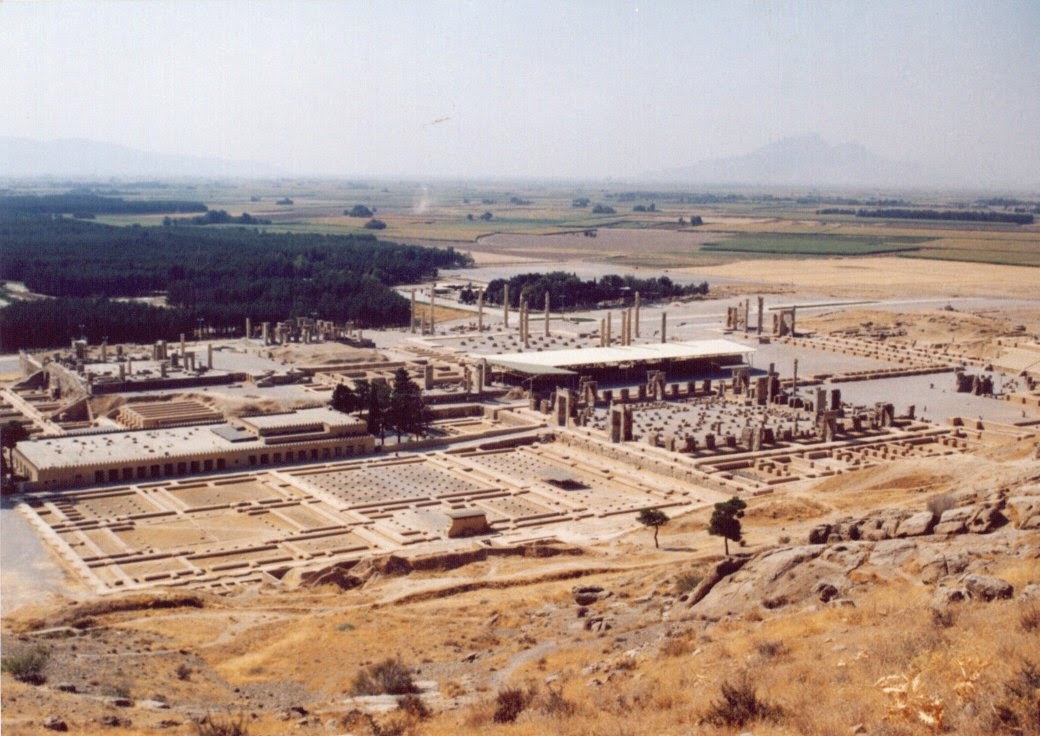
Near Shiraz lie the magnificent ruins of Persepolis.


Persepolis or Takht e Jamshed
 
If the name Shiraz sounds familiar, it is: The grapes which originated there make a splendid wine, made all over the world but not not in the Islamic Republic of Iran which is dry. I am told that there is a booming trade in grape juice; now, home brew being illegal, why would anybody want large quantities of grape juice?

Written on the walls of Persepolis are cunieform texts by Xerxes, Artaxerxes, Darius…. names to conjure with indeed. In the bible “Darius the Mede” was the man who conquered the competing empire of the Babylonians and released the captive Jews from their enslavement “by the rivers of Babylon”. I slept on the rocks just above the tombs of these great kings. Up there were some form of workings: nothing spectacular, but they ould have formed part of the winching mechanism used whilst the tombs were cut into the cliff face below.

On of my early formative experiences was watching “swords and sandles” film epics such as Three Hundred Spartans in which the clean-limbed and western-looking Spartans are beseiged by the scowling swarthy black-hatted fuzzy-wuzzy Persians from the evil East. Of course, the Persians were unfairly blackened. This magnificent city was every bit as elegant and civilised as Athens. Their kings were buried in rock-cut tombs in the cliff face that looks over the gently sloping site. The view is stunning. The tombs of Artaxerxes II and III were blocked off by scaffolding poles, but a crafty guide was making a bit on the side using his little spanner. For a pittance, he let me into the cool rock cavity and I hopped up onto the massive sarcophagus of a Persian emperor.

The Greek-Persian war was won decisively by the Greeks. Alexander conquered the Persian Empire. When he took Persepolis his troops burnt the place down, either accidentally or deliberately. The Iranians disagree that it is called Persepolis, a name Greek in origin. It's rather like Hitler had renamed Paris Frankstadt. It was called Parsa in the day (we're talking about 300 years before Caesar) and under the Muslims it is called Takht e Jamshed.


Magnificent Persepolis. Note the body language of the visiting surrogate king.

When I had arrived the previous evening, night was falling. I decided to kip out in a stand of trees. After offloading all my clutter, a couple of dodgy kids riding a horse came up to me and cadged a fag. They started telling me a better place to camp, at the corner of a maize field which was surrounded on three sides by plouged earth. Sure, I thought. As if I’m going to give away my location to a scouting party for a band of brigands. They proceeded to pillage the maize field, presumably for horse feed. As soon as they cleared off, I headed in the opposite direction for some privacy. But from time to time I would see a white trail appear in the semi-darkness, and realise that I was being quietly stalked by these kids on their horse, whose hooves were quietly kicking up the dust. Eventually, I found a little gully and skulked down to observe. My little friends were carrying out a systematic search of the area.

To keep my position secret, I had to camp in the maize field. No fire. No torch. No noise. When I stuck out my head to observe the corner they had proposed, a group of people were gathered there. But they didn’t know where I was, even if they had any ill intent.

----------------- 

Before founding the magnificent Persepolis, the rock-tombs of the kings were sited in the nearby Naqsh e Rostam. Here lie Darius I, Darius II, Artaxerxes I and Xerxes. Over every tomb, up over our heads, is carved a likeness of the king and the winged figure of Ahura Mazda. Darius is referred to in the Bible as "Darius the Mede", the king who defeated Babylon and liberated the Jews from their captivity by the rivers of Babylon.


Tombs of the Kings of Persia

It got dark soon after I arrived, so I decided to leg it round the corner and see if I could climb up to spend the night on top of the cliff. When I got up there, there were rock-cut structures associated with the building of the floodlit tombs below - some form of winch arrangement. I had to be careful not to slip and fall fifty metres. In the end, I tired of trying to attract the attention of my mate the security guard as he tatted around his shack. He didn’t see my torch or hear my whistle. Next morning I appropriated his washroom for a luxurious shave, and to replenish my water supplies.

It was time to head back towards Tehran for the flight home. I strolled to a main road intersection a couple of miles distant to flag down a passing coach. A traffic cop had a decent-sized shed there. He invited me over, made me tea, gave me a cigarette. I then go to the roadside to await a coach, but he beckons me out to his 4WD squad car, puts my pack in the back, and tells me to get in. I… er… think everything is cool. I go to get in the front passenger seat (where an equal sits) but he waves me to the back seats. Oh, dear. His colleague, whom I hadn’t known about, gets in the front, and we head off north. I have explained that I’m heading towards Esfehan (400 km away) and then Tehran. They surely are not going to drive me all this way. We have a good old chitchat, with much exchanging of cigarettes (God bless ‘em, the great tokens of laddish unity). The body language signals are all on green. Gulp. After a few miles they pull over. Gulp. We are on a dead straight stretch of road. A coach appears, and my man stands with his hand raised, all cold supercilious authority. When the coach stops, just past us, I make to run to the door, but he shooshes me to stop; it’s undignified; we’re in control. The bus driver is furious that this copper is trying to foist an infidel tourist on him, and drives off. The next coach is similarly overcrowded, but the centre-man on the front seat gives up his place for me, and stands the whole trip.

I get out my GPS and tell them how far we are from Esfehan. (Word goes back along the coach… he has a wondrous little device.) People behind begin to tap me on the shoulder. Where am I from? Ah, Inglistan! (Word goes back along the coach.) Do I have family? Bale.. do dochtar. Stephanie, hijdah, and Nathalie bist-o-se. (Word goes back down the coach: he has two daughters….)

The Iranian people are the most hospitable on the planet. As a shameless attention-seeker, to have people taking an interest in the petty details of my petty life is most rewarding. They are piss-poor, but as friendly and courteous as can be. Somebody asked me what we thought of Iran in the West. I replied, “In England, people laughed when I said I was coming to Iran. They said that Iran is a dangerous country, a nest of terrorists; they would cut my throat and dump my body in a ditch.” The person was appalled. “Buy why? Why do they say such bad things about Iran?” “The newspapers tell us this, that the people of Iran are all bad people.”

In an underground restaurant in Yazd, the place where Mohammad Reza and I had shared a hubbly bubbly, I later had a meal. All alone at my single table, I was called over by an English-speaking man, a tour guide, to sit with him and his colleagues. As the conversation wore on, his driver leaned across the table and spoke to me in Farsi. “What did he say?” “My driver said, ‘Tell Mrs. Thatcher and John Major to send British SAS to come to Iran and kill the fucking mullahs’.” I was appalled: “We must not speak like this! I did not come to Iran to talk politics. It is dangerous. I will talk about football, about family, about food, but not politics!”

Iran is a young country. Unlike England where the streets are full of old fogies, Iran has such a high birth rate that there are young people everywhere. Twenty years after the fall of the Shah, they do not remember the Islamic Revolution, and have a hankering for western goodies, material and cultural. My tour guide confidently predicted that there would soon be another revolution by the supporters of the popular President Khatami, who was losing so many struggles with the mullah-dominated courts.

With the exception of the pick-pocket episode, I never felt in any danger in Iran. Although they are repressed and poor, they have many values, such as family values and sociability, which we in the west have lost.


An ancient form of air conditioning

We Europeans hear all the bad stuff about Iran; we are blind to the many positives. They have poets and philosophers on a par with our Shakespeares and Aristotles. In a queue somewhere I got into conversation with a dishy young teacher (in full burkah) trying to control a gaggle of unruly pupils. In my Lonely Planet was a passage from Hafeez or Rumi or Omar Khayyam. I asked her to read it for me. The mere sound of the words was hypnotic. It was almost mesmerising. Where poetry is concerned I am a barbarian; I just don't get it; I say brusque things like, "If there's any meaning there then why don't they just come out and say it rather than dressing it up in all these silly flowery rhymes?" Although I could not understand the words she spoke, this young teacher may just have helped show me that poetry isn't just frilly froth.

One small passage by Omar Khayyam goes:

The Moving Finger writes; and, having writ,
Moves on: nor all thy Piety nor Wit
Shall lure it back to cancel half a Line,
Nor all thy Tears wash out a Word of it.

Magic!

My Iranian holiday was a stunning, vivid holiday, which I shall look back on fondly forever.